
Easy Ways To Use Up Stale Or Leftover Bread
To support the running costs of Moral Fibres, this post may contain affiliate links. This means Moral Fibres may earn a small commission, at no extra cost to readers, on items purchased through these links.

Wondering what to do with stale or leftover bread? I have lots of tips to help you reduce your food waste that definitely aren’t crumby.
Food waste is a huge issue. Food production is one of the biggest contributors to climate change. In fact, about one-third of greenhouse emissions globally come from agriculture alone.
Despite this, both at the household level and at the manufacturing level, we are very wasteful when it comes to food.
Thirty per cent of the food we produce is wasted – about 1.8 billion tonnes of it a year. So much so that it has been estimated that if food waste was a country, it would be the third-highest emitter of greenhouse gases after the US and China.
When it comes to bread, in the UK we waste a staggering 800,000 tonnes of bread and other baked goods a year. And of this, a shocking 680,000 tonnes is avoidable. So, to help combat this waste, I’ve put together heaps of handy tips with ideas on what to do with leftover bread.
What To Do With Stale Or Leftover Bread

Here are all my best tips to help you cut food waste and save some dough!
Ignore The Best Before Date
I always ignore best-before dates as they refer to food quality rather than safety (which use by dates refer to). If the bread looks ok, with no mould on it, and smells ok, then the chances are it’s fine to eat. If it feels a little hard, then it will probably taste better toasted.
Do check for mould carefully, though, before you tuck into your sandwich or toast. Some bread mould can be white, and it can be hard to distinguish between flour and mould. If you are in doubt, don’t eat it!
Revive Stale or Hard Bread
Has your crusty loaf gone stale or rock hard? Worry not, it can be revived using water and the heat of your oven.
To revive stale or hard bread:
- Briefly hold the leftover bread under a cold tap. It doesn’t need a soak, just so the crust feels damp rather than dripping.
- Then give it a shake to remove any excess water.
- Next, pop it in a hot oven (around 180°C or so) for around 10 minutes. This will make your bread lovely and soft again, making the perfect rescued sandwich.
This method works because the moisture turns to steam in the hot oven, which relaxes the crumb, making it soft again. Meanwhile, the outside dries back to a crisp finish.
Individual rolls, hot dog buns, croissants, bagels, or any similar bread-based snack can also be given a similar treatment. All you have to do is wrap them in a damp piece of kitchen roll and microwave them for 10 seconds to pop the freshness back.
Make Breadcrumbs From The Ends
Most of us throw out the ends of our bread. In fact, in the UK alone, we waste 1.2 billion crusts of bread each year. This is the equivalent to equivalent to binning 50 million loaves of bread every year.
But did you know you can make breadcrumbs out of the ends of bread? It’s a handy way to use up the bread that one in five of us discard.
The most energy-efficient way to make bread crumbs is to store your ends of bread in a tub or bag in the freezer until you have enough to fill your food processor with. Before freezing, it’s best to tear the heel of your bread into small pieces to make it easier to work with.
Once you have enough bread squirrelled away in your freezer, you can make breadcrumbs with this easy recipe:
- Place the frozen pieces of bread in your food processor, and pulse until you reach your desired coarseness.
- Next, spread the crumbs onto a baking tray – so that they are around half a centimetre deep – and place them into a low oven (150°C/gas mark 2) for around 20 to 30 minutes. Stir the crumbs gently halfway through cooking.
- Remove the breadcrumbs from the oven when they turn a light golden-brown colour and feel dry to the touch.
These breadcrumbs keep for a few weeks in an airtight container, or for 3 months in the freezer. Use them for all kinds of dishes -such as topping veggie bakes or coating homemade bean burgers.
Make Croutons
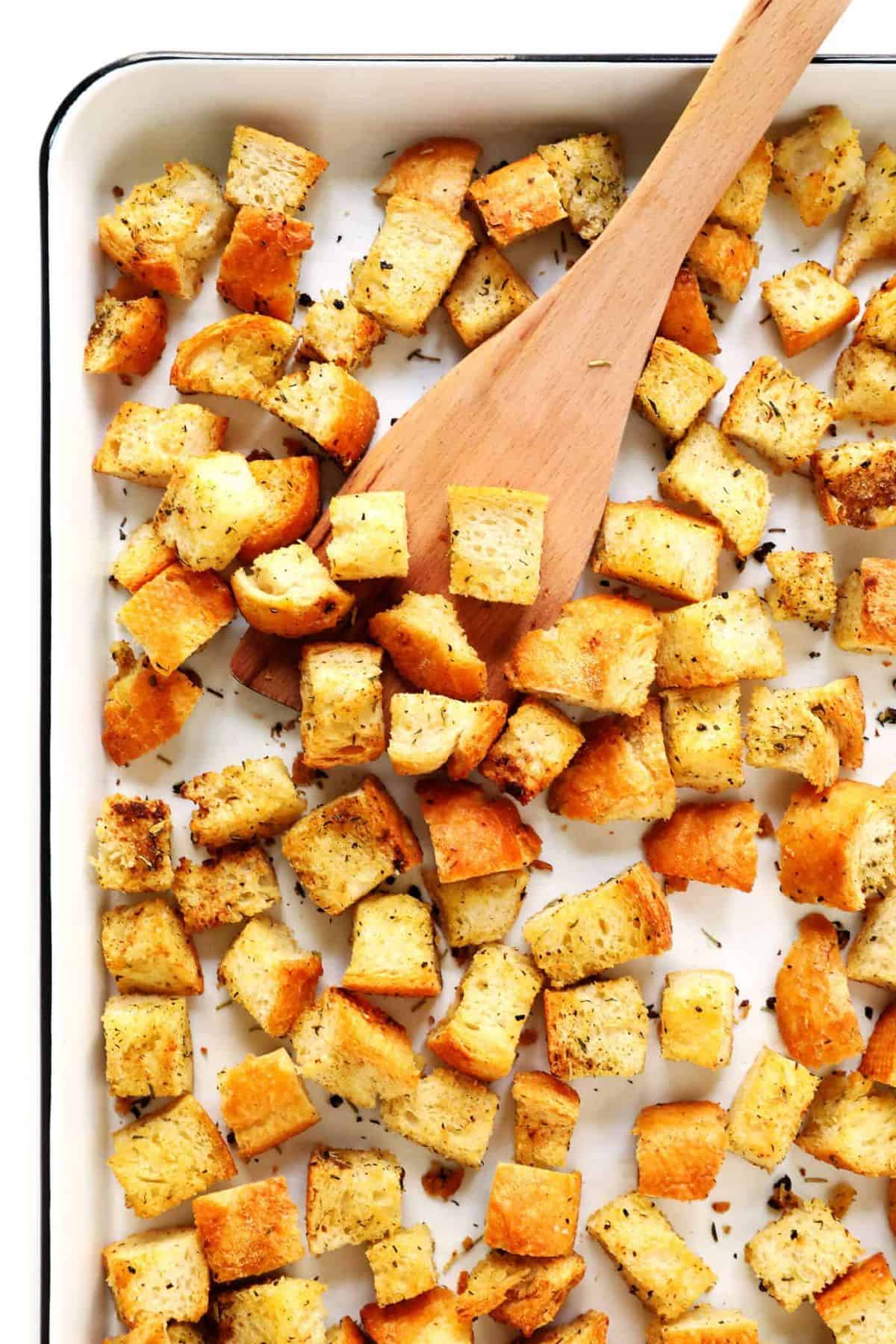
Stale bread is ideal for making croutons with. These add a welcome crunch to salads and soups.
Gimme Some Oven, photographed above, has an easy recipe for croutons that take, around 20 minutes to make. Once made, these can be stored in an airtight jar for around a week.
Try Recipes for That Call For Stale Bread
Leftover bread can be used in myriad recipes – from sweet to savoury.
Panzella, for example, is a tasty seasonal Italian dish that specifically requires the use of stale bread to make this delicious tomato salad.
I’m also a big fan of making bread and butter pudding with stale bread. My personal favourite is whisky and marmalade bread and butter pudding. I make a variation of this recipe every Christmas, adding some dark chocolate chips to make it extra decadent!
Ways To Avoid Bread Waste

It’s handy knowing some useful tips on what to do with your old bread. However, I always think one of the most impactful ways to make a change is to change your habits so that you have less bread left over.
Here are my top tips to help you shop and store smarter:
Use Your Freezer
You can freeze bread – preferably on the day you buy it. However, you can freeze your bread right up to its best-before date, and it can last for up to 6 months in the freezer.
Slices can then be toasted from frozen or defrosted and used as normal within a day, with no perceptible differences in taste or texture.
If you have leftover cake (this never happens in my house!), then it’s worth knowing that many cakes can also be frozen, either in slices or whole. Bon Appetit has some great advice for freezing cake.
Don’t Store Bread In the Fridge
Bread lasts longer stored in a cool, dark, and dry place, such as in a bread bin or cupboard.
Whatever you do, avoid using the fridge to store your bread. Storing bread in the fridge draws moisture out of the bread. This causes it to go stale six times faster than if you’d stored your loaf in a cupboard or bread bin.
Shop Smarter
Finally, if you find yourself rarely finishing a standard-sized loaf of bread, then why not consider changing your shopping habits? Instead, you could buy a half-loaf of bread, which will cut your food waste and save you money at the same time.
More Top Food Waste Tips
Looking for more top tips to help you make more of your food:
- Here’s an easy way to test if eggs are safe to eat.
- Did you know sniffing the carton of milk isn’t a good indicator of freshness? Instead, here’s the correct way to tell if milk is off.
- Here’s a fun tip to make berries last longer in the fridge.
- And here are lots of easy ways to use up black bananas.
Found this post useful? Please consider buying me a virtual coffee to help support the site’s running costs.
Sign Up For The Moral Fibres Substack
Get all the latest articles from Moral Fibres straight to your inbox, once a month, free of charge through Substack. You can also upgrade to be a paid Substack subscriber, where you’ll receive an additional two exclusive articles a month. Sign up now:


As long as the bread is eaten, I don’t really view it as wasted. The wild birds and ducks near my house always get a few slices so it never ends up in the bin. Just don’t put bread out for the birds while they have chicks in the nest – it can choke them.
Hey A-M, it’s quite a common misconception about feeding bread to birds – it isn’t actually the best thing to feed birds. It doesn’t have much nutritional benefit to them, so should only be given to birds as part of a variety of foods that you set out in your garden, and should be soaked first. I wrote a bit about feeding birds here if you’re keen to read a bit more about it: https://moralfibres.co.uk/feeding-wild-birds-in-your-garden/ And you’re totally right about not putting it out when there are chicks!
Nice tips. Thanks for sharing.