
Easy Pickled Cucumber Recipe With Fennel Flowers
To support the running costs of Moral Fibres, this post may contain affiliate links. This means Moral Fibres may earn a small commission, at no extra cost to readers, on items purchased through these links.

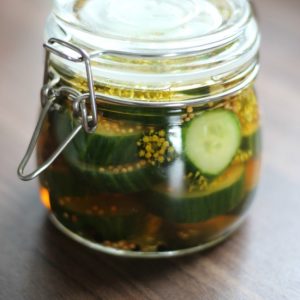
Here’s an easy vegan-friendly pickled cucumber and fennel flower recipe, for when cucumbers are at their very best.

Every August we get an overabundance of flowering fennel. It takes over quite a large corner of our garden. However, rather than dig up the bulbs to eat, the flowering fennel is something we want to keep. The bees and wasps absolutely love it. As well as helping wildlife, attracting wasps to our garden helps keep our caterpillar population at a minimum – companion planting for the win!
Fennel is in season from June until September in the UK, so I like to use fennel fronds in cucumber salad in the summer. Cucumbers are also in season from June through to September, so overlap with fennel season quite nicely. However, I’d never done anything with the fennel flowers before.
I’ve always wondered if I could perhaps share the fennel flowers with the bees and wasps. As such, I thought about pickling cucumbers with fennel instead of traditional dill. I gave it a go and was pretty delighted with the results. So delighted in fact, that I thought I’d share the pickled cucumber recipe with you.
The fennel flower gives the pickled cucumber that extra flavour hit. And the good thing is the recipe uses only a few fennel flower heads so there will be plenty left for the bees and wasps!
How To Make Pickled Cucumber With Fennel Flowers

adapted from Debora Robertson
Ingredients
- 3 cucumbers
- 3 fennel flower heads (approximately)
- 500 ml cider vinegar
- 400 ml white wine vinegar
- 120 ml water
- 4 tablespoons sugar
- 2 teaspoons mustard seeds
- 1 teaspoons peppercorns
- 6 garlic cloves finely sliced
- 2-3 tablespoons salt
Equipment Needed

- A collection of clean, lidded with vinegar-proof lids. I used six jars (one large and five small, but you may need less than this if you use larger jars).
- A sharp knife
- 2 plates
- A pan
- A clean tea towel
Method

- Slice the ends off your cucumbers and discard, then slice the cucumbers into coins, roughly 1.5cm thick.
- Sprinkle salt on a plate and cover the plate with one layer of cucumber slices. Sprinkle salt on top of that layer then add another layer of cucumber on top. Continue salting and layering your cucumber until all of your cucumber has been salted. I ended up using two plates. Leave for two hours to macerate.
- Whilst you are waiting for your cucumbers to macerate, you can make the pickling brine. To do this, simply add the vinegars, water, sugar, garlic slices, mustard seeds and peppercorns to a pot and heat gently over a low heat, stirring until the sugar has dissolved. Once you’ve done this leave this mixture to cool.
- After about 1 hour and forty minutes sterilise your jars and lids. To sterilise jars see my easy guide to sterilising jars.
- Once your two hours are up, rinse the salted cucumbers and pat them dry with your clean tea towel.
- Place the cucumbers into your jars and evenly divide the fennel flowers between the jars. Pour the brine over the cucumbers and fennel, leaving half a centimetre from the lid of the jar. Seal and leave in a cool dark place for 48 hours at the absolute least, but preferably a week. The longer you leave it the greater the taste, so patience really is a virtue!
- The jars should keep for around 3 months unopened. If you want you can place your sealed jars in a bath of boiling water for 5 minutes to process them – this should mean they will keep for around a year, unopened. They do soften a bit using this method, so it depends on whether you want your cucumbers crunchy or not.
- Once opened, keep your pickles in the fridge and use within a fortnight.
Serving Ideas

Pickled cucumber can be enjoyed in a multitude of ways. We’ve found that it works well as a topping in a veggie burger, in place of a gherkin, in sandwiches, with cheese, in salads, or my favourite – straight from the jar!
I hope you enjoy this easy pickled cucumber recipe! It’s definitely a firm favourite in our house! Do let me know if you find other tasty ways to enjoy it.
A Note On Vinegar-Proof Jars
In the recipe, I mentioned that you want to ensure your lids are vinegar-proof. What this means is that there isn’t any metal that can touch the vinegar. If you don’t use vinegar-proof lids, the vinegar can react with the metal lid. This would give the pickled cucumber a metallic taste, which is something you want to avoid
If you’re using old jars that you’re recycling, then look for lids with a plastic lining in them. The good thing is if you’re using jars that previously contained any pickle, chutney, mayonnaise, or tomato sauce then the lids are pretty much going to be vinegar-proof. The only lids I’ve seen which aren’t vinegar-proof tend to be lids from honey jars. Kilner clip jars are also good for pickle making.
Printer-Friendly Version
If you’d like to print this recipe out for later, you can use this recipe card. Just click the ‘print recipe’ button:
Easy Pickled Cucumber Recipe with Fennel Flowers
Ingredients
- 3 cucumbers
- 3 fennel flower heads (approximately)
- 500 ml cider vinegar
- 400 ml white wine vinegar
- 120 ml water
- 4 tablespoons sugar
- 2 teaspoons mustard seeds
- 1 teaspoons peppercorns
- 6 garlic cloves finely sliced
- 2-3 tablespoons salt
Instructions
- Slice the ends off your cucumbers and discard, then slice the cucumbers into coins, roughly 1.5cm thick.
- Sprinkle salt on a plate and cover the plate with one layer of cucumber slices. Sprinkle salt on top of that layer then add another layer of cucumber on top. Continue salting and layering your cucumber until all of your cucumber has been salted. I ended up using two plates. Leave for two hours to macerate.
- Whilst you are waiting on your cucumbers to macerate, make the pickling brine. To do this, simply add the vinegars, water, sugar, garlic slices, mustard seeds and peppercorns to a pot and heat gently over a low heat, stirring until the sugar has dissolved. Once you've done this leave this mixture to cool.
- After about 1 hour and forty minutes sterilise your jars and lids.
- Once your two hours are up rinse the salted cucumbers and pat dry with a clean tea towel.
- Place the cucumbers into your jars and evenly divide the fennel flowers between the jars. Pour the brine over the cucumbers and fennel, leaving half a centimetre from the lid of the jar. Seal and leave in a cool dark place for 48 hours at the absolute least, but preferably a week. The longer you leave it the greater the taste, so patience really is a virtue!
- The jars should keep for around 3 months unopened. If you want you can place your sealed jars in a bath of boiling water for 5 minutes to process them – this should mean they will keep for around a year, unopened. They do soften a bit using this method, so it depends on whether you prefer your cucumbers with a bit of crunch or not.
- Once opened, keep your pickles in the fridge and use within a fortnight.
Found this post useful? Please consider buying me a virtual coffee to help support the site’s running costs.
Sign Up For The Moral Fibres Substack
Get all the latest articles from Moral Fibres straight to your inbox, once a month, free of charge through Substack. You can also upgrade to be a paid Substack subscriber, where you’ll receive an additional two exclusive articles a month. Sign up now:


Gosh, we never have enough cucumbers left to pickle! They get eaten as soon as they are ripe!
Wow, I’ve learned something new. I thought you had to have special gherkins to pickle, I never knew you could pickle ordinary cucumbers – thanks for the education!
My pleasure! :)