
13 Sneaky Things You Can’t Recycle At Home
To support the running costs of Moral Fibres, this post may contain affiliate links. This means Moral Fibres may earn a small commission, at no extra cost to readers, on items purchased through these links.

Are you unwittingly making any recycling faux pas? Here are 13 sneaky things you can’t recycle at home that may surprise you.
Recycling can feel like an enigma wrapped in a conundrum sometimes. I’m sure many of us have hovered over our recycling bins, trying to guess if an item is actually recyclable or not.
The problem is that uncertainty over what can and can’t be recycled can lead to ‘wishcycling‘. Also known as ‘aspirational recycling’, this is when we think that something is recyclable, even though it’s not.
It may not sound like a big problem. However, despite being well-intentioned, wishcycling is a huge headache for recyclers and the environment. Non-recyclable items mixed in with recyclable ones can cause contamination. This can mean that whole batches of waste – even the waste that can actually be recycled – can potentially end up in landfill.
If you want to help increase the chance that your recycling can be recycled and made into something new, here are thirteen sneaky non-recyclable household objects to be aware of.
13 Things You Can’t Recycle At Home
Ready to learn more about recycling? Use the quick links to jump to a specific section, or keep scrolling to read the full guide:
- Receipts
- Toothpaste Tubes
- Tomato Paste Tubes
- Compostable Coffee Cups
- Certain Types Of Gift Wrap
- Broken Glassware
- Nail Polish Bottles
- Train Tickets
- Tissues & Kitchen Roll
- Photo Paper
- Plastic Toys
- Clothes Hangers
- Cutlery
Receipts

Most receipts are made from thermal paper – a special type of paper that reacts with heat to display text. To achieve these thermal properties, the paper is coated in BPA, an industrial chemical which renders receipts unsuitable for recycling or composting. This means you should pop these receipts in the general waste bin.
Want to know more? Here are the full details on why you can’t recycle receipts – and some handy tips to tell if your receipt is thermal or not.
Toothpaste Tubes
Toothpaste tubes – and other squeezable tubes – can be tricky to recycle. This is because they’re usually made from a mix of materials that are tightly fused together – often made using a thin layer of aluminium that’s sandwiched between several layers of plastic.
Separating those layers is both tricky and expensive for recyclers. So instead, those empty tubes often end up in landfill.
In recent years, the big names in dental care have promised to make all their toothpaste tubes recyclable by 2025. Most are moving over to HDPE – short for high-density polyethylene – a type of plastic that is used to make milk bottles. Unlike the old mixed-material tubes, HDPE is much easier to recycle.
However, some brands still haven’t switched over. And even if your favourite brand has, there’s no guarantee your local council will accept HDPE toothpaste tubes for recycling just yet. As such, it’s worth checking with your local authority before popping any empty tubes into your recycling bin.
Tomato Paste Tubes
In a similar vein, it’s worth noting that even 100% metal tomato paste tubes often can’t be recycled at home.
Unlike tin cans, metal tubes are difficult to rinse out properly, especially when they’ve been squeezed and crumpled to get the sauce out. This means they’re usually still coated with leftover paste. This leftover residue can spoil entire batches of recycling, which is why local authorities are cautious about accepting them.
Unless your council says that they specifically accept them, it’s best to keep these tubes out of your kerbside recycling bin.
Compostable Coffee Cups

Any item that says it’s suitable for industrial composting only, such as compostable coffee cups, can’t be recycled at home. This means you shouldn’t put them in your paper recycling or your food and garden waste bin.
These types of materials aren’t suitable for paper and cardboard recycling as they are made of a type of plant-based plastic. And they can’t be composted either. This is because these items don’t break down at the same rate as food and garden waste in standard local authority composting facilities, and cause problems in these facilities.
As such, coffee cups should be recycled at cafes that pay to access industrial composting schemes, or they should go in your general waste bin.
Want to know more? Here are all the details on why you can’t compost industrially compostable materials at home.
Certain Types Of Gift Wrap
Wrapping paper isn’t always recyclable. This is because some types of gift wrap – even if they feel papery – are often laminated with very thin layers of plastic to help strengthen the paper. Meanwhile, foil or glitter-decorated paper also contains plastic.

To check if your paper is recyclable, scrunch the paper into a ball, as in the video above. If it stays scrunched, it can generally be recycled. Just make sure you remove any sellotape, ribbons or bows first. If it unravels, it contains plastic and should go in the bin.
Looking to ditch plastic-based wrapping paper? Try my sustainable gift-wrapping ideas for lots of eco-friendly suggestions.
Broken Glassware
Another potential recycling slip-up is when you are dealing with broken glassware.
Whilst drinking glasses are made of glass, they are made from a different combination of materials than glass bottles and jars. This is because they are heat-treated, so they do not melt at the same temperature as other glass items. This surprisingly makes them unsuitable for recycling. So if you’ve broken a drinking glass, it should go in your general waste bin.
Alternatively, you can recycle broken drinking glasses at your local recycling centre. Pop the broken glass in the hardcore and rubble section, so it can be reused in construction projects.
Nail Polish Bottles
Despite being made of glass, nail varnish bottles shouldn’t be placed in with your glass recycling. The nail varnish inside is difficult to remove and could contaminate other glass that can be recycled. Instead, pop the empty bottles in your general waste bin.
Train Tickets
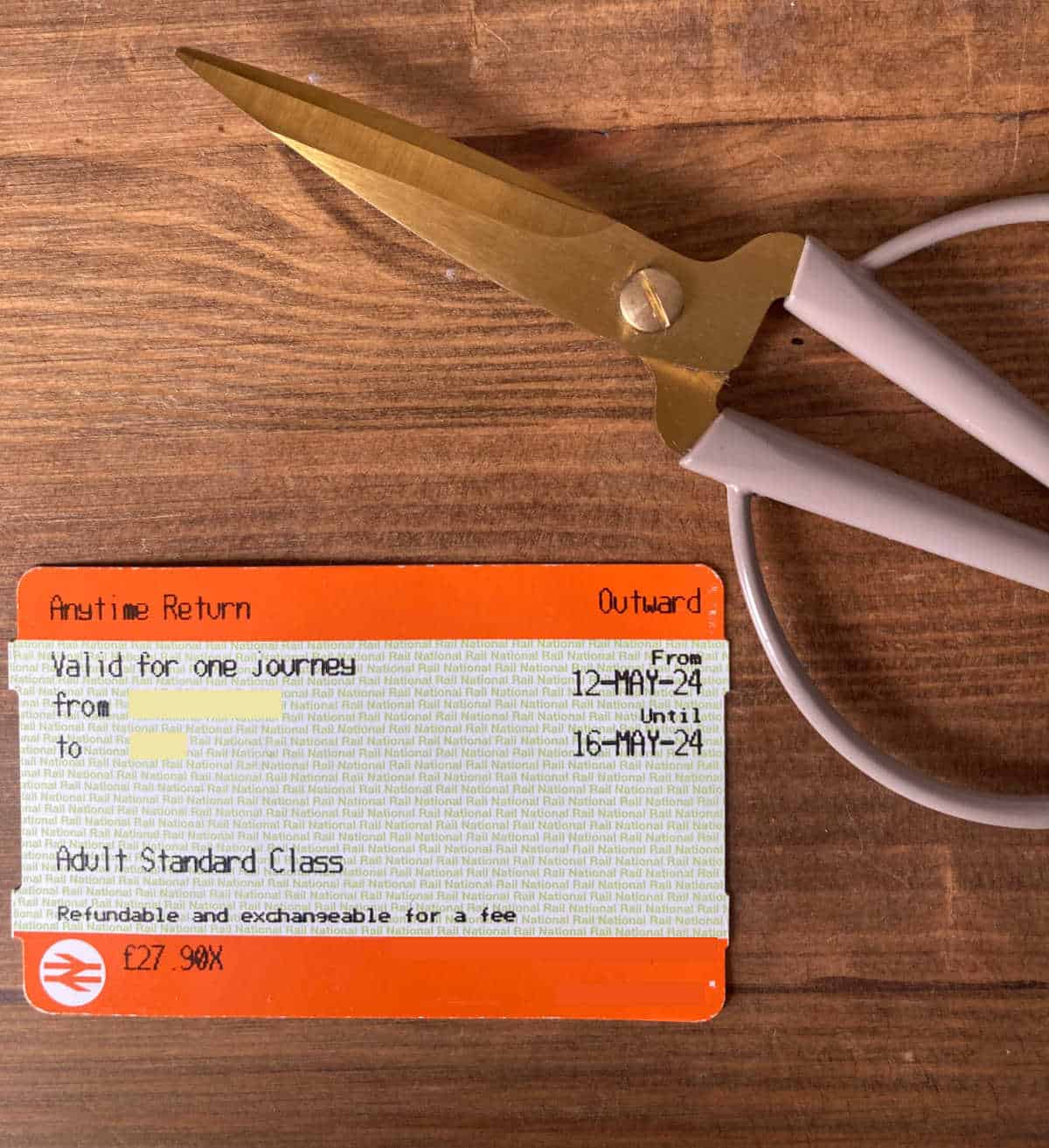
If you’ve been issued an orange and yellow card train ticket, like mine in the photo above, then it’s reasonable to assume it is recyclable. After all, it’s made of card.
However, the black strip on the back of the ticket – the bit that holds all the information about your journey so that you can get through the automatic barriers – contains a mix of metallic and volatile components. These are too tricky to separate in the recycling paper recycling process, so they should be placed in your general waste bin.
One way to avoid train tickets is to try looking into what alternatives your train operator offers. This may include eTickets, mobile apps or pre-loadable smart cards.
Tissues & Kitchen Roll
Whilst sheets of kitchen roll and tissues are made of paper, the sheets shouldn’t be recycled. This is because they are usually contaminated with food, cleaning products or general household mess, which could contaminate paper and cardboard recycling. Instead, put used sheets in your general waste bin.
The cardboard tubes can be recycled, though. Tissue boxes can also be recycled as long as you remove any plastic lining they may have.
Check out my guide to sustainable alternatives to kitchen roll if you’re looking for a greener alternative.
Photo Paper
Photo paper can’t be recycled. This is because the paper has a plastic film covering that isn’t easy to separate. The paper also contains small amounts of silver and chemical coatings that could contaminate paper recycling. Instead, it should go in your general waste bin.
Plastic Toys
If plastic toys irreparably break, you may wonder if you can put them in your plastic recycling bin. Sadly, you can’t. This is because plastic toys are made from what is known as ‘hard plastic’. This is a different type of plastic that can’t be recycled in the same way as food packaging made from plastic.
You may be able to find toy recycling schemes in your local area. If not, consider finding alternative uses for your broken toys (Pinterest is your friend here), or put them in your general waste bin.
Clothes Hangers
Most clothes hangers – whether they are made of plastic, metal, or wood – can’t be recycled at home. Instead, try donating them to charity shops, which may take hangers in good condition to reuse. Alternatively, you could offer them for free on online marketplaces.
If they’re broken or can’t be reused, your local recycling centre may take them in specific bins, depending on the material. Call ahead or check your council’s website before making a trip to get regional-specific advice.
Cutlery
Finally, metal cutlery is another surprisingly sneaky thing that cannot be recycled at home. This is because our kerbside recycling process is only designed to sort steel and aluminium cans, tins and foil.
Instead, any old cutlery that cannot be reused should be recycled with scrap metal at your local household waste recycling centre. Here, it will be reclaimed, melted down, and used to create new products.
Found this post useful? Please consider buying me a virtual coffee to help support the site’s running costs.
Sign Up For The Moral Fibres Substack
Get all the latest articles from Moral Fibres straight to your inbox, once a month, free of charge through Substack. You can also upgrade to be a paid Substack subscriber, where you’ll receive an additional two exclusive articles a month. Sign up now:


Some companies (Smol & Suri are the two I’m thinking of) have aluminium toothpaste tubes. I’m guessing that this is the same problem as tomato puree tubes then?
Yes, it’s the same for toothpaste tubes and skincare products in aluminium tubes. Some councils can recycle them and others won’t so it’s best to check with your local council if they can accept them or not.
Hai Wendy! Just wondered about plastic toys – our local recycling centre accepts ‘rigid plastics’, I suppose as long as there are no electronic components, the plastic toys could go there? I’ll call them and find out.
Sorry, I’m not sure – recycling varies so much from county to county. If in doubt it’s always best to contact your local council for advice local to you.
Lego ‘paper’ bags also can’t be recycled. I contacted Lego as I wasn’t sure if I could put them in my compost bin. They are coated in polyethylene. Lego suggested to that it was ‘technically’ recyclable. I contacted my local council – they won’t accept them. I can email you to transcript if you like. It took Lego an age to actually give me an answer.
Hi Sophie, my kids don’t play with Lego anymore, so I wasn’t quite sure what you were referring to, but I just looked up the Lego website and I can see they’ve swapped the plastic bag the bricks used to come in to what Lego is calling a ‘paper-based’ bag. It says on the site that “The bags are made out of 95% paper with the remainder being a thin plastic coating, which purpose is to protect the LEGO® elements from puncturing the bag as well as gluing the bag together.” I’m not sure I quite understand the change – it’s still plastic – so I would be as frustrated as you are!
No, this can’t be true? If so is this not greenwashing at its highest degree?!
Hi. As I understand it, almost all food packaging cannot be recycled because it is made a many layers of microscopically thin plastic film which are all different grades. Only single layer plastics can be recycled. This leaves just transparent or white plastic bottles, coloured bottle screw caps or yoghurt pots. Paper packaging is the worst because it is usually glued to a thin plastic film inside. So buying things unpacked by weight and accepting a rather short shelf life (3/4 days) is the only really green way to go unfortunately.
Hi Patricia, yes, there’s only a few plastics we can recycle at home. I’ve recently written an article on what happens to the things we put in our recycling bins for a publication. Once it’s printed I think I can share it here, so keep an eye out for it!